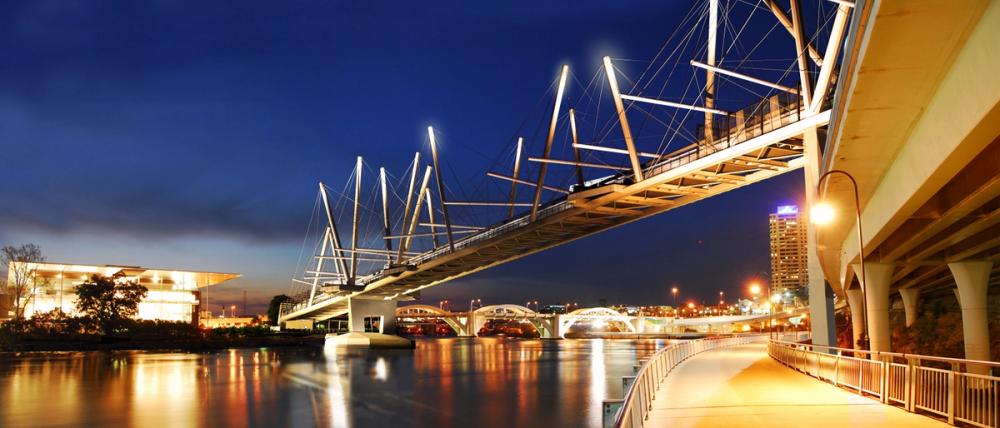
An award-winning pedestrian and cycle bridge connecting South Brisbane to the CBD.

Kurilpa Bridge
Client
Department of Housing & Public Works
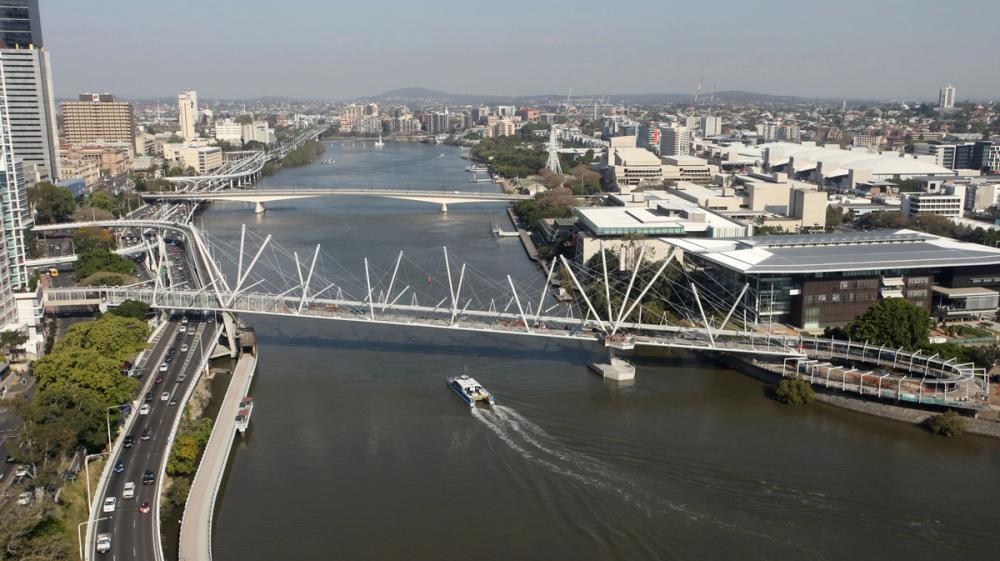
Enhancing active‑transport connectivity, this $64.5 million project delivered the world’s largest hybrid tensegrity bridge, featuring a 128‑m main span and a total length of ~470m. Since its opening October 2009 it has become a defining piece of Brisbane’s contemporary architectural identity.
Design & Structural Features
Designed by Cox Architecture and Arup Engineers, the bridge showcases a tensegrity‑inspired structural system that uses a series of masts, flying spars and over 6.8–7 km of high‑strength steel cables to balance compression and tension forces. This creates an exceptionally lightweight yet strong structure that visually appears to ‘float’ above the river. The deck comprises structural steel and precast concrete panels with a continuous all‑weather canopy supported by a secondary tensegrity system.
At 6.5 metres wide, the bridge accommodates pedestrian and cyclist traffic and includes viewing platforms, rest areas and a programmable solar‑powered LED lighting system that illuminates the structure at night.
A core component of RCP’s role involved managing complex time‑risk issues, the sequencing of steel mast and cable installation, and the high‑precision construction tolerances required for the tensegrity superstructure where dimensional errors as small as a few millimetres could jeopardise critical path progress.
Construction Challenges & Staging
The project required advanced programming due to its engineering complexity and the constraints of building over a deep, fast‑flowing river.
Key challenges included:
- precision alignment of 20–30 m masts and 80+ cable systems
- night‑time steel installation works with strict river‑traffic controls
- staged cantilever construction from river piers
- maintaining Brisbane River navigation and environmental protection
- working adjacent to the cultural precinct and GoMA.
RCP coordinated construction timetabling to ensure safe delivery of nightworks, managed multi‑agency approvals and oversaw stakeholder communication with adjoining precinct owners.
The bridge enhances active‑transport connectivity between Brisbane’s CBD and the South Bank cultural precinct, supporting walking and cycling networks and contributing to Brisbane’s subtropical design identity. Its sculptural form has become a modern landmark and a symbol of innovation within the city’s public infrastructure portfolio.